GEOTECHNICALENGINEERING1
SANTA ANA
HomeLaboratoryTriaxial test

Triaxial Testing in Santa Ana: Shear Strength Parameters for Foundation Design

Geotechnical engineering with regional judgment.

LEARN MORE

Santa Ana sits on the deep alluvial basin of the Santa Ana River, where the water table can be found less than 80 feet below the surface in many neighborhoods. This high groundwater, combined with the city's proximity to the Newport-Inglewood Fault, means site soil often contains saturated silts and fine sands that behave differently under load. A standard penetration test tells you blow counts. But a triaxial test tells you how the soil skeleton actually fails. In a seismic zone like Orange County, drained and undrained shear strength parameters are not optional—they are the difference between a safe foundation and a costly settlement problem. Our team runs consolidated-undrained (CU) and consolidated-drained (CD) triaxial tests on undisturbed Shelby tube samples, delivering the effective stress parameters engineers need for projects across Santa Ana.

Effective stress friction angles from triaxial testing often reduce foundation dimensions by 15% compared to conservative total stress assumptions.
Our service areas

Methodology and scope

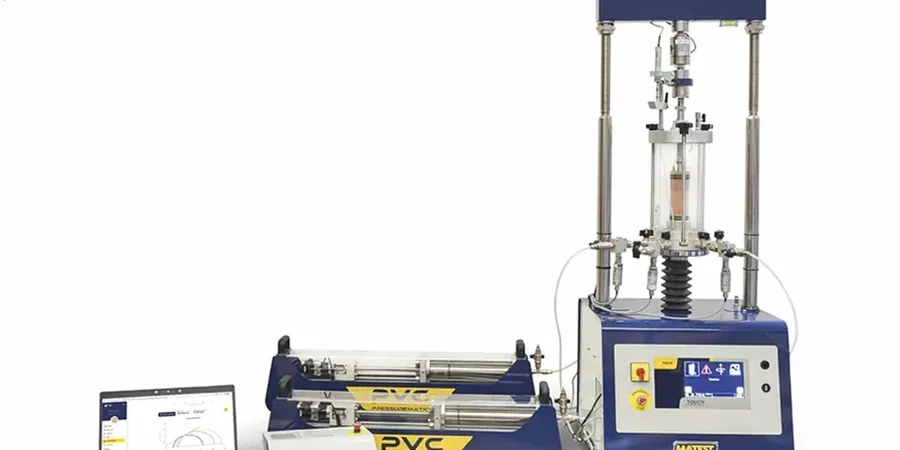
The triaxial cell used for Santa Ana projects applies confining pressures up to 150 psi, replicating the stresses at depths where deep foundations and basement walls are placed. We follow ASTM D4767 for CU tests with pore pressure measurement and ASTM D2850 for unconsolidated-undrained (UU) quick checks on cohesive fill. A digital pressure-volume controller saturates the specimen using back-pressure until Skempton's B-value exceeds 0.95. Then we shear at a rate slow enough to allow pore pressure equalization—critical for the low-permeability silty clays common in the city's older floodplain deposits. For granular materials where undisturbed sampling is difficult, we often recommend pairing this with CPT testing to establish a continuous stratigraphic profile before selecting specimens for triaxial analysis.
Triaxial Testing in Santa Ana: Shear Strength Parameters for Foundation Design
Technical reference — Santa Ana

Site-specific factors

A mid-rise apartment project near the Civic Center encountered a layer of saturated sandy silt at 25 feet. The geotechnical report used total stress parameters from unconfined compression tests. During excavation, the shoring system deflected more than predicted. The problem was not the shoring design—it was the soil model. Total stress methods ignored the positive pore pressures that developed in the silt during undrained loading. A follow-up CU triaxial test on undisturbed samples from the same depth revealed an effective friction angle of 28 degrees, not the 14 degrees assumed. Redesigning the shoring with effective stress parameters eliminated the excessive deflection. In Santa Ana's basin deposits, ignoring pore pressure behavior during shear is a risk no project can afford.

Need a geotechnical assessment?

Reply within 24h.

Email: info@geotechnicalengineering1.biz

Reference standards

ASTM D4767 Standard Test Method for Consolidated Undrained Triaxial Compression Test for Cohesive Soils, ASTM D2850 Standard Test Method for Unconsolidated-Undrained Triaxial Compression Test on Cohesive Soils, ASTM D7181 Method for Consolidated Drained Triaxial Compression Test for Soils, IBC Chapter 18 Soils and Foundations, ASCE 7 Minimum Design Loads for Buildings and Other Structures

Typical values

ParameterTypical value
Confining Pressure Range5–150 psi (35–1035 kPa)
Test TypesUU, CU, CD per ASTM D2850/D4767
Pore Pressure Parameter B> 0.95 saturation verified
Specimen Diameter2.8 in (71 mm) standard
Shear Rate (CU)0.005–0.02 in/min
Data OutputMohr-Coulomb c' and φ'

Common questions

When does a Santa Ana project need a triaxial test instead of a direct shear test?

Triaxial is required when pore pressure behavior matters. Direct shear drains freely and cannot measure undrained strength. Any Santa Ana project with saturated fine-grained soils, deep excavations below the water table, or seismic slope stability analysis needs triaxial data. The IBC requires effective stress parameters for these conditions, and direct shear cannot provide them.

What is the typical turnaround time for triaxial testing in Santa Ana?

Standard CU triaxial tests take 7 to 10 business days from specimen preparation to final report. This includes saturation, consolidation, and shear phases—each consolidation phase alone can take 24 to 48 hours depending on soil permeability. UU tests are faster, typically 3 to 4 business days. Rush service is available for projects on tight construction schedules.

How much does a triaxial test cost for a Santa Ana project?

Triaxial testing in Santa Ana typically ranges from US$1,880 to US$3,090 depending on the test type and number of confining pressures. A single UU test on one specimen starts at the lower end. A full CU suite with three confining pressures and pore pressure measurement reaches the upper end. Specimen extrusion and trimming from Shelby tubes is included.

How many triaxial tests do I need for my Santa Ana site?

Minimum three specimens per soil unit to define a Mohr-Coulomb failure envelope. If your Santa Ana boring log shows three distinct soil layers, plan for at least nine specimens total. More tests reduce uncertainty in the strength parameters, which directly impacts the resistance factors you can use in LRFD foundation design.

Can you test granular soils from Santa Ana in the triaxial cell?

Yes, but sample preparation is critical. Undisturbed sampling of clean sands is difficult. We use frozen sampling or reconstituted specimens compacted to field density. For many granular sites in Santa Ana, we recommend combining triaxial on fine-grained layers with CPT data for the sand units to build a complete strength profile.

Location and service area

We serve projects in Santa Ana and surrounding areas. More info.

View larger map