GEOTECHNICALENGINEERING1
SANTA ANA
HomeRoadwayRigid pavement design

Rigid Pavement Design in Santa Ana: Performance That Withstands the Load

Geotechnical engineering with regional judgment.

LEARN MORE

Drive from the historic French Park neighborhood over to the industrial corridors near Edinger Avenue, and you'll feel the difference under your tires. One stretch rolls smooth after years of traffic; the other cracks and heaves within seasons. The difference isn't just the contractor, it's what's underneath. Santa Ana sits on a mix of younger alluvial deposits from the Santa Ana River and pockets of older, denser Pleistocene terraces, which means subgrade stiffness can change drastically within a single project site. A rigid pavement design that works near the Civic Center may fail completely half a mile east if the slab thickness and joint spacing don't account for the actual soil profile. We skip the guesswork. Our team drills, samples, and tests the subgrade on your lot before a single structural calculation begins, linking the geotechnical reality to the pavement structure so the concrete slab performs for decades, not just until the next wet winter.

In Santa Ana, the difference between a 20-year slab and a 5-year failure is usually 18 inches of poorly understood subgrade.
Our service areas

Methodology and scope

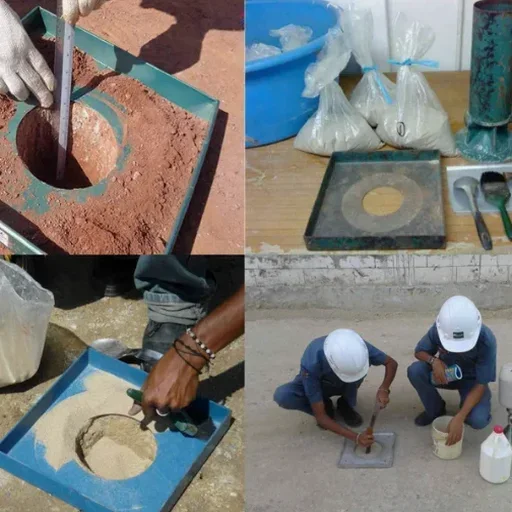
At roughly 33.75° North, Santa Ana deals with a semi-arid climate that tricks the soil into a shrink-swell cycle few designers account for. Summer highs above 90°F dry out the upper clays, then winter rains saturate them fast, generating volume changes that punch right through a slab if the base layer lacks proper drainage. Our rigid pavement design process tackles this head-on with a thorough geotechnical investigation. We log the stratigraphy, run laboratory tests for plasticity and grain size, and calculate the modulus of subgrade reaction (k-value) from field plate load data, not from look-up tables that assume uniform ground. We also integrate the CPT test when the project demands continuous profiling of soft lenses or undocumented fill, giving us the precision needed to model slab curling stresses and fatigue consumption under the expected truck traffic. The output isn't a generic cross-section; it's a pavement structure tuned to the exact soil calendar of your Santa Ana site, including joint layout, dowel bar sizing, and base course specification per AASHTO 93 and local agency supplements.
Rigid Pavement Design in Santa Ana: Performance That Withstands the Load
Technical reference — Santa Ana

Site-specific factors

Santa Ana's growth after the 1950s pushed development into areas that had been agricultural floodplain for generations. That legacy left behind lenses of silty loam and organic clay that were never engineered to carry heavy truck axles. When a warehouse or a cold storage facility goes up today on a former orchard parcel, the rigid pavement is at immediate risk of pumping, faulting, and corner breaks if the subgrade wasn't uniformly improved. We've seen slabs fail in under three years because the design assumed a uniform clay when the reality was a buried sand lens that created differential support. Our approach treats each lane and each loading dock as its own micro-zone. We map the subgrade variability with borings and in-situ testing, then adjust the pavement structure section by section. This means thicker slabs where the k-value drops, edge beams at the dock face, and positive drainage that keeps water out of the base course, all detailed in a plan set your contractor can execute without interpretation errors.

Need a geotechnical assessment?

Reply within 24h.

Email: info@geotechnicalengineering1.biz

Reference standards

AASHTO 93 Guide for Design of Pavement Structures, IBC Chapter 18 (Soils and Foundations) with Santa Ana municipal amendments, ASTM C78 / C293 (concrete flexural strength testing), ASTM D1196 (nonrepetitive static plate load test for k-value), Caltrans Standard Specifications, Division 40 (concrete pavement)

Typical values

ParameterTypical value
Design Traffic (ESALs)Per AASHTO 93, projected 20-year equivalent single axle loads
Modulus of Subgrade Reaction (k)Determined by field plate load test (ASTM D1196) or CPT correlation
Concrete Flexural Strength (MR)Specified at 28 days, typically 550-650 psi for municipal arterials
Joint SpacingCalculated per PCA method, considering slab thickness and aggregate type
Base TypeCement-treated base (CTB) or unstabilized granular, with drainage coefficient per IBC
Terminal Serviceability Index (pt)2.5 for major highways, 2.0 for industrial lots, per AASHTO design guide

Common questions

What is the typical rigid pavement thickness for an industrial yard in Santa Ana?

It depends entirely on the subgrade k-value and the expected truck traffic. For a typical Santa Ana warehouse with daily semi-truck loading, we often see designs between 7 and 9 inches of unreinforced concrete over a cement-treated base, but this must be confirmed by a site-specific geotechnical investigation. We never prescribe a thickness without first testing the soil.

How much does a rigid pavement design package cost for a Santa Ana project?

A complete package, including the field investigation, laboratory testing, and the stamped engineering design report, typically ranges from US$1,680 to US$6,570 depending on the yard size, the number of borings required, and the traffic loading complexity. We provide a fixed-fee proposal after reviewing your site plan.

Do you handle the plan check process with the City of Santa Ana?

Yes. Our design reports and drawings are prepared to meet the current submittal requirements of the Santa Ana Public Works Department. We address plan check comments directly and can revise the pavement design if the reviewing engineer requests adjustments based on local utility conflicts or updated traffic data.

How do you account for the expansive soils common in parts of Santa Ana?

We sample the upper subgrade and run Atterberg limits and expansion index tests. If the soils show moderate to high expansion potential, we recommend a moisture-conditioned subgrade, a thicker aggregate base, or chemical stabilization with lime or cement to create a buffer layer that isolates the slab from the shrink-swell zone, preventing the cracking patterns we see in older Santa Ana pavements.

Location and service area

We serve projects in Santa Ana and surrounding areas. More info.

View larger map