GEOTECHNICALENGINEERING1
SANTA ANA
HomeInvestigationCPT (Cone Penetration Test)

Cone Penetration Testing (CPT) in Santa Ana, CA

Geotechnical engineering with regional judgment.

LEARN MORE

Much of Santa Ana sits atop the Santa Ana River floodplain, where Holocene alluvium creates layers of silts and sands with occasional clay lenses that challenge shallow foundation design. Groundwater can appear as shallow as 25 to 30 feet in central parts of the city, directly impacting liquefaction susceptibility under the seismic demands of the Newport-Inglewood Fault. A Cone Penetration Test delivers a continuous, high-resolution log of tip resistance, sleeve friction, and pore pressure — exactly the data required to model these stratified deposits without the sample disturbance inherent in traditional drilling. We combine this real-time stratigraphy with shear wave velocity profiling to refine site class per ASCE 7, and then integrate the results into liquefaction trigger analyses that satisfy both IBC Chapter 18 and the local building official’s review requirements.

Continuous cone data cuts through Santa Ana's alluvial variability: three parameters per inch, zero sample disturbance, one decisive borehole.
Our service areas

Methodology and scope

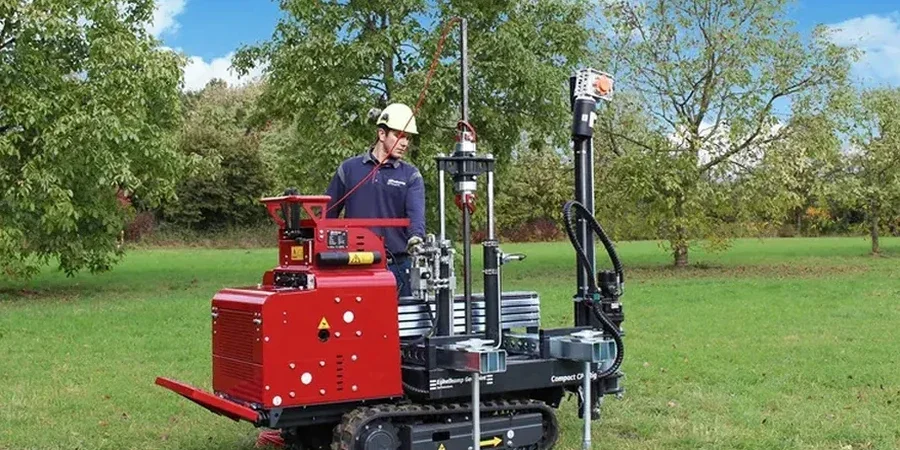
Soil conditions shift noticeably across Santa Ana. In the downtown core and older neighborhoods near Santiago Park, dense alluvial sands and gravels at 15 to 18 feet depth yield cone resistances above 150 tsf — favorable for shallow footings but still demanding verification. Farther south toward South Coast Metro, deeper clay beds and silt layers produce friction ratios above 4 percent, flagging compressible behavior that can lead to differential settlement if ignored. Our 20-ton CPT rig runs continuous soundings to 70 or even 80 feet where required, capturing the transition from the upper stiff crust into the softer Holocene deposits below. For sites where traffic vibration or adjacent structures limit drilling, we pair CPT data with surface wave testing to fill shear wave velocity gaps without additional disturbance — a practical approach that has streamlined permitting for several mixed-use projects near the Civic Center.
Cone Penetration Testing (CPT) in Santa Ana, CA
Technical reference — Santa Ana

Site-specific factors

Santa Ana's semi-arid climate masks a critical geotechnical risk: the shallow water table fluctuates dramatically between dry summers and wet El Niño winters, altering the effective stress regime in the upper 30 feet. A cone test run in September can yield pore pressure data starkly different from a sounding taken in February. That seasonal swing directly affects interpreted undrained shear strength and liquefaction factor of safety. We address this by scheduling CPT campaigns strategically — and when a project timeline demands off-season investigation, we correct dissipation test data using site-specific seasonal piezometric records from the Orange County Water District. The difference between a peak summer cone profile and a winter one can shift foundation recommendations from a mat slab to driven piles in borderline liquefiable zones. Overlooking that nuance is what turns a routine mid-rise project near Edinger Avenue into an expensive post-construction settlement claim.

Need a geotechnical assessment?

Reply within 24h.

Email: info@geotechnicalengineering1.biz

Reference standards

ASTM D5778 – Standard Test Method for Electronic Friction Cone and Piezocone Penetration Testing of Soils, IBC 2021 (California adoption) – Chapter 18 Soils and Foundations, with Santa Ana municipal amendments, ASCE 7-22 – Minimum Design Loads, Section 11.8 Site Classification based on seismic CPT data, Robertson & Wride (1998) – CPT-based liquefaction triggering framework, Caltrans Geotechnical Manual – CPT interpretation for transportation infrastructure

Typical values

ParameterTypical value
Maximum testing depth70–80 ft standard; deeper with pre-drilling
Tip resistance (qc) range10 tsf (soft fill) to 200+ tsf (dense sand/gravel)
Sleeve friction (fs) range0.1–4.0 tsf
Pore pressure (u2) sensor5 MPa transducer, saturated filter element
Friction ratio (Rf) classificationPer Robertson (1990) and updated SBTn charts
Push rate standard2 cm/sec ±10% per ASTM D5778
Sampling interval1 cm continuous digital record
Seismic CPT optionDownhole shear wave velocity every 1 m

Common questions

What does a CPT test cost in Santa Ana?

For a standard CPT sounding to 60–70 feet depth with pore pressure measurement, budget between US$140 and US$280 per hour of rig time, with typical mobilization adding a flat day-rate. Most single-family or small commercial sites in Santa Ana require one to three soundings. Seismic CPT adds a modest per-sounding surcharge for the geophone array and data reduction. We provide a fixed-price quote after reviewing the site address and depth requirements — no hidden charges for traffic control or confined access within city limits.

How does CPT compare to SPT drilling for Santa Ana alluvial sites?

CPT provides a continuous digital record — tip resistance, sleeve friction, and pore pressure every centimeter — whereas SPT captures data only at 5-foot intervals and disturbs the sample. In Santa Ana's layered floodplain deposits, a 5-foot gap can miss a thin liquefiable silt lens entirely. CPT also eliminates drill cuttings and spoils, which simplifies logistics on tight urban lots. The trade-off: CPT does not retrieve a physical soil sample, so if laboratory index testing is required, we sometimes pair one CPT with one mud rotary boring for sampling.

Is CPT accepted by the City of Santa Ana for foundation design submittals?

Yes, the City of Santa Ana Building Division accepts CPT data as a primary site investigation method when performed under ASTM D5778 and interpreted by a California-licensed geotechnical engineer. We routinely submit CPT-based reports for shallow and deep foundation design, liquefaction analysis, and grading plan review. The key requirement is that the report includes both raw data and interpreted engineering parameters with clear justification — which our deliverables provide as standard.

How long does a CPT investigation take from field work to report?

For a typical two-sounding campaign in Santa Ana, field work is completed in one day assuming no major access constraints. Data processing, soil behavior type classification, and engineering parameter derivation take an additional two to three business days. Full geotechnical report with foundation recommendations, liquefaction analysis, and construction considerations is typically delivered within seven to ten business days after field completion. Expedited turnaround is available for time-sensitive projects.

Location and service area

We serve projects in Santa Ana and surrounding areas.

View larger map