GEOTECHNICALENGINEERING1
SANTA ANA
HomeSlopes & WallsActive/passive anchor design

Active and Passive Anchor Design for Santa Ana Excavation Support

Geotechnical engineering with regional judgment.

LEARN MORE

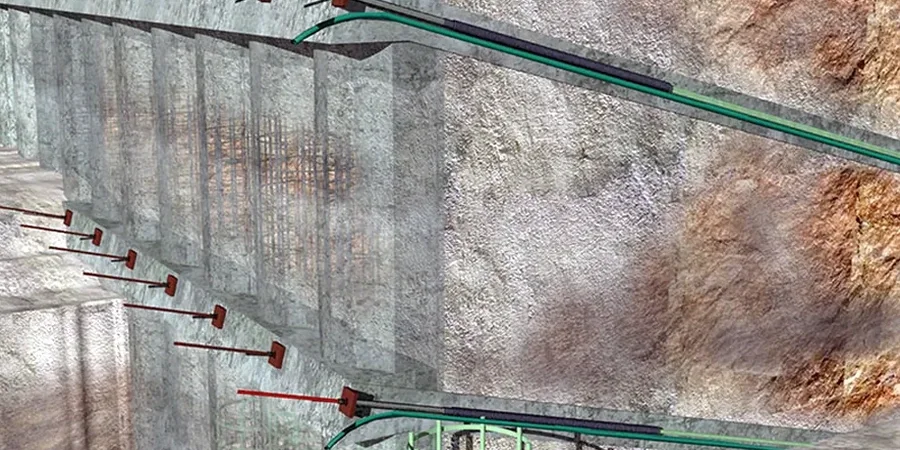
A hydraulic drilling rig setting up in a tight Santa Ana lot is a common sight for our field crews. The rotary head spins down through the shallow fill, pushing past the silty sands of the Tustin plain to reach competent bearing strata for the bond length. Unlike simple soil nailing, active anchor design applies a lock-off load immediately, pre-compressing the soldier pile wall and limiting movement before excavation proceeds. In the mixed alluvium found near the Santa Ana River, selecting the right post-grouting technique makes the difference between a dry excavation and a costly blowout. We size the high-strength steel tendons and the corrugated sheathings based on the actual friction ratio recorded in the field, not just textbook values. Before the stressing jack applies final tension, every anchor undergoes a performance test, a step that is critical when your project site sits within 5 miles of the Newport-Inglewood fault's secondary splays. The equipment might look like standard ground engineering gear, but the methodology adapts to the dense over-consolidated clays that appear once you get past the 20-foot mark in central Santa Ana.

A properly designed active anchor limits lateral movement to under half an inch, even with a five-story building vibrating next door.
Our service areas

Methodology and scope

The semi-arid climate of inland Orange County creates a sharp contrast in soil moisture that directly governs anchor capacity. During the dry summer months, stiff upper clays may hold a temporary borehole perfectly, but the winter rains saturate the sandy lenses beneath Downtown Santa Ana, increasing hydrostatic pressure on the shoring system. A passive anchor relies purely on this soil-grout interface shear, meaning its performance hinges on how accurately we profile the loose layers with a CPT test before installation. Active tendons, conversely, transfer load beyond potential failure wedges, and we frequently combine their installation with a slope stability analysis to verify global factors of safety for deep cuts. The interaction between the unbonded free-stressing length and the bond zone must be isolated meticulously; even minor grout intrusion into the free length can cause catastrophic tendon failure under seismic loading, a scenario we prevent through pressure-controlled tremie methods. For projects confronting shallow groundwater tables in the city's western basin, we design double-corrosion protection systems that extend the service life of permanent anchors well past the 75-year mark required by the IBC.
Active and Passive Anchor Design for Santa Ana Excavation Support
Technical reference — Santa Ana

Site-specific factors

The soil profile varies dramatically between the historic French Park neighborhood and the commercial corridor along South Main Street. Near French Park, you encounter sandy loam that drains easily, but shifting over to Main Street, you hit pockets of highly plastic clay that swell when wet and shrink when dry, a dangerous environment for passive anchors relying on constant radial stress. The biggest risk to a tieback system in Santa Ana isn't just the static earth pressure; it is the cyclic loading induced by a moderate earthquake on the blind thrust faults underlying the basin. A passive anchor installed without verifying the ultimate bond stress through extended creep tests can undergo progressive relaxation, effectively pulling out silently over months. Active systems eliminate much of that slack, but if the stressing sequence is not staggered properly along a continuous waler beam, the load transfer can crush the concrete facing. Our approach involves proof-testing every single anchor on the job to 133% of the design load, holding the jack steady while the digital gauge records any deflection. We also map the proximity to the abandoned Santiago Creek paleochannels, where buried organic debris can create voids that collapse during drilling, threatening the integrity of the annular grout column.

Need a geotechnical assessment?

Reply within 24h.

Email: info@geotechnicalengineering1.biz

Reference standards

PTI DC35.1-14: Recommendations for Prestressed Rock and Soil Anchors, ASCE 7-22: Minimum Design Loads for Buildings and Other Structures, IBC 2022 (California Amendments): Section 1807 on Earth Retaining Systems, ASTM A416: Standard Specification for Low-Relaxation Steel Strand, FHWA Geotechnical Engineering Circular No. 4: Ground Anchors

Typical values

ParameterTypical value
Design StandardPTI DC35.1 / IBC 2022 / ASCE 7-22
Typical Lock-off Load70% to 110% of Design Load (Fd)
Bond Length Minimum15 ft for cohesive soils, 10 ft for rock
Tendon Steel GradeASTM A416 Grade 270 (low-relaxation strand)
Performance Test Creep< 0.04 in over 60 minutes at 133% Fd
Corrosion ProtectionClass I (Permanent) or Class II (Temporary)
Unbonded LengthMinimum 15 ft or extends past Rankine wedge

Common questions

What is the typical price range for an active anchor system in Santa Ana?

The cost for a fully tested active anchor usually falls between US$1,060 and US$3,390 per unit, depending on the total bonded length, the number of strands, and the complexity of the corrosion protection required for permanent structures.

How do you verify the capacity of an anchor after installation?

We perform a proof test on 100% of production anchors, holding the jack at 133% of the design lock-off load for a minimum of 10 minutes. We monitor creep with a digital dial gauge; movement must stabilize below 0.04 inches over the final 60-minute window to pass.

Is active or passive anchoring better for the sandy soils found near the Santa Ana River?

Active anchors are generally preferred near the river due to the loose alluvial sands and potential for liquefaction. Applying a lock-off load immediately compresses the ground, reducing the risk of settlement under the adjacent footings before the excavation reaches its final depth.

How close to the property line can you install a tieback anchor?

We can angle the drill mast to install anchors almost directly under the public right-of-way, provided we secure an easement from the city. Our low-headroom rigs allow us to drill steep inclinations at the very edge of the shoring wall, maximizing the bond length within the property's subsurface footprint.

What prevents the anchor from corroding underground over the decades?

For permanent installations, we use a Class I protection system: the steel strand is fully encapsulated in a corrugated plastic duct filled with a high-density, low-permeability cement grout. The stressing anchorage at the head is sealed with a protective grease cap and concrete cap, isolating the steel from the oxygen-rich soil near the surface.

Location and service area

We serve projects in Santa Ana and surrounding areas. More info.

View larger map