GEOTECHNICALENGINEERING1
SANTA ANA
HomeLaboratoryAtterberg limits

Atterberg Limits Testing in Santa Ana: Reliable Soil Classification

Geotechnical engineering with regional judgment.

LEARN MORE

In Santa Ana, the near-surface soils often mislead builders. A dry summer crust hides fat clays underneath. We see this pattern across the city, from the Civic Center area to the industrial lots near South Coast Metro. The issue is moisture. When it rains, those clays swell. When it’s dry, they shrink. That movement cracks slabs and shifts shallow footings. Atterberg limits testing cuts through the guesswork. It gives us the liquid limit, plastic limit, and plasticity index. With those three numbers, we classify the soil per ASTM D4318 and the Unified Soil Classification System. No surprises later. Just data. For deeper bearing layers, we pair this with SPT drilling to confirm stratigraphy before the structural design locks in.

A plasticity index above 25 in Santa Ana means one thing: the clay will move. Plan for it.
Our service areas

Methodology and scope

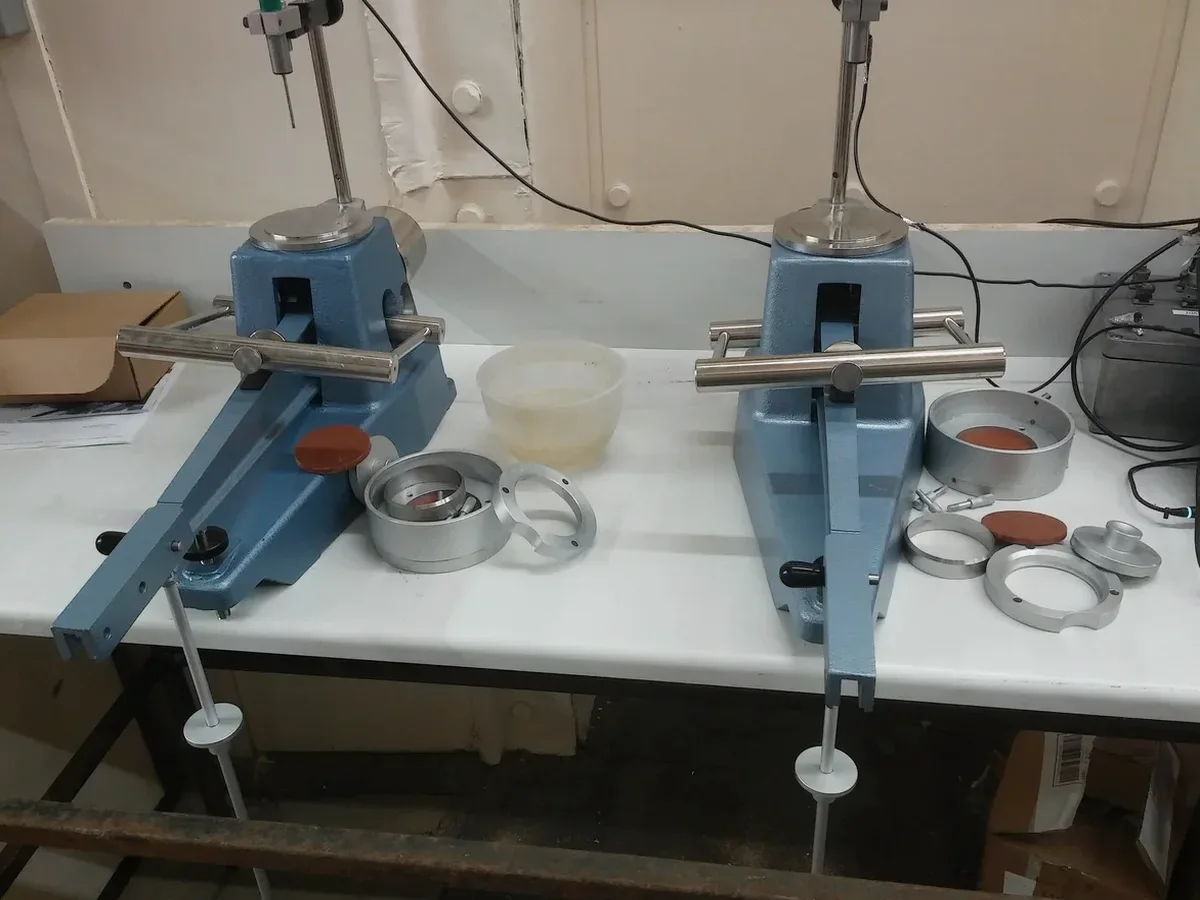
The soil profile changes fast across Santa Ana. The historic downtown sits on older alluvial deposits. The terrain toward the Santa Ana River carries more recent silts and fine sands. Plasticity varies block by block. A sample from a site near the 55 freeway might show a liquid limit of 45 and a PI of 22, while a lot near MainPlace Mall tests as low-plasticity silt. Same city, very different behavior. That’s why we run the full set: liquid limit via the Casagrande cup method, plastic limit by thread rolling, and the calculated plasticity index. We also check the shrinkage limit when volume change is a concern. For road subgrade, these results feed directly into the CBR pavement design. For foundation support, they define the expansion potential and guide the need for vibrocompaction or over-excavation.
Atterberg Limits Testing in Santa Ana: Reliable Soil Classification
Technical reference — Santa Ana

Site-specific factors

Santa Ana sits at roughly 115 feet elevation, with a dense urban grid built over expansive alluvial soils. The 1933 Long Beach earthquake reminded every engineer in the region that settlement and liquefaction risk are real. But for shallow foundations, the silent cost is expansive clay. A PI over 30, common in pockets near the Santiago Creek paleochannels, can exert swelling pressures that heave a slab-on-grade by two inches or more. That’s not a crack. That’s a structural failure. Skipping Atterberg limits risks misclassifying the soil as low-risk silt when it’s actually high-plasticity clay. The fix costs ten times more after framing is up. We test early. We classify correctly. We keep the foundation design on solid ground, literally.

Need a geotechnical assessment?

Reply within 24h.

Email: info@geotechnicalengineering1.biz

Reference standards

ASTM D4318: Standard Test Methods for Liquid Limit, Plastic Limit, and Plasticity Index of Soils, ASTM D2487: Standard Practice for Classification of Soils for Engineering Purposes (USCS), ASTM D427: Test Method for Shrinkage Factors of Soils, IBC Chapter 18: Soils and Foundations

Typical values

ParameterTypical value
Liquid Limit (LL)Water content at soil transition to liquid state
Plastic Limit (PL)Water content at soil transition to semi-solid state
Plasticity Index (PI)PI = LL - PL
Liquidity Index (LI)In-situ water content relative to limits
Shrinkage Limit (SL)Water content below which volume is constant
Activity (A)PI / % clay fraction, indicates mineral type
USCS ClassificationCL, CH, ML, MH per ASTM D2487

Common questions

What do Atterberg limits tell me about my Santa Ana site?

They define the water contents where fine-grained soil changes from solid to plastic to liquid. The Plasticity Index (PI) tells you how much water the soil can absorb before it becomes unstable. In Santa Ana, a PI above 25 signals expansive clay behavior that requires special foundation measures.

How much does Atterberg limits testing cost?

The lab test runs between US$60 and US$100 per sample for the full suite of liquid limit, plastic limit, and plasticity index. The total cost depends on how many samples we need to characterize your site. We recommend at least three samples per distinct soil layer.

How long does the lab test take?

Standard turnaround is 3 to 5 business days from sample receipt. We can expedite to 24 hours for time-sensitive projects. The test itself requires controlled drying and multiple moisture content determinations, so rushing it compromises accuracy.

Can I skip Atterberg limits if I only have sandy soil?

If your site is purely clean sand with less than 5% fines, Atterberg limits won't apply. But in Santa Ana, many sands contain silt and clay lenses. We always run a grain size analysis first. If the fines fraction exceeds 12%, running the limits is essential to avoid misclassifying the soil.

Location and service area

We serve projects in Santa Ana and surrounding areas.

View larger map