GEOTECHNICALENGINEERING1
SANTA ANA
HomeLaboratoryGrain size analysis (sieve + hydrometer)

Grain Size Analysis in Santa Ana: Sieve & Hydrometer Testing

Geotechnical engineering with regional judgment.

LEARN MORE

A recent mixed-use development near Santa Ana's civic center ran into unexpected silty layers at just six feet down. The contractor needed to know fast: was this material suitable for backfill, or would it hold water and delay the schedule? Grain size analysis gave the answer. In a city where alluvial deposits from the Santa Ana River meet pockets of engineered fill and older marine terrace remnants, guessing the gradation curve is a gamble no project can afford. We run the full sieve stack plus hydrometer when fines exceed the No. 200 sieve, delivering a complete particle size distribution that drives compaction specs, permeability estimates, and USCS classification. For earthwork contractors pushing tight City of Santa Ana grading deadlines, that curve isn't just a lab report — it's the difference between passing compaction on the first lift and reworking material for three extra days.

A soil's behavior under load and water is written in its gradation curve — miss the fines content and you misread the entire site.
Our service areas

Methodology and scope

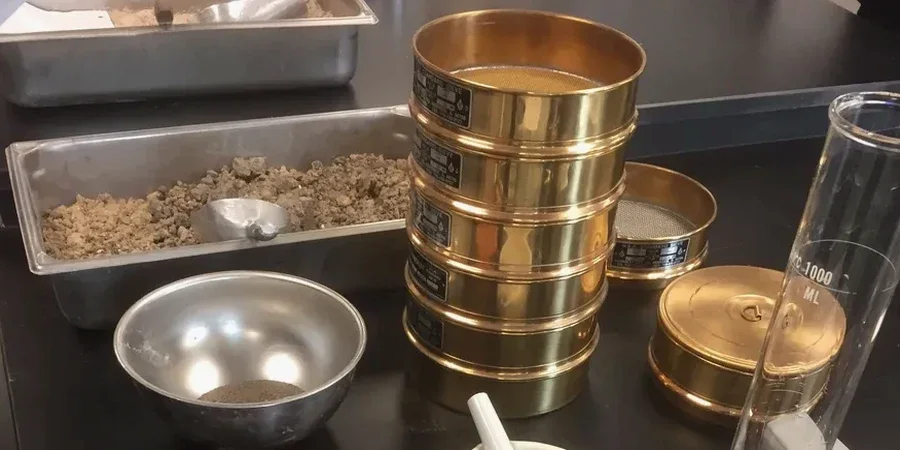
Per ASTM D2487 and D422, every soil classification in Santa Ana starts with the grain size curve. The city's geologic setting — with its mix of young alluvium, older dissected terraces, and localized artificial fill — means two borings fifty feet apart can yield completely different gradations. We wash each sample through a nest of sieves from 3-inch down to No. 200, then run the minus-200 fraction through a hydrometer test that tracks settlement rates over a 24-hour period. The combined curve tells you the percentages of gravel, sand, silt, and clay, which directly feeds into the USCS group symbol. This matters enormously for projects that also require CBR testing for road design, where the gradation influences subgrade strength predictions. When the soil plot straddles the A-line on the plasticity chart, we pair the grain size data with Atterberg limits testing to nail the classification without ambiguity, especially on those borderline silty sands common in the floodplain areas south of First Street.
Grain Size Analysis in Santa Ana: Sieve & Hydrometer Testing
Technical reference — Santa Ana

Site-specific factors

Not all Santa Ana soils behave the same way. The sandy loams found near the Delhi neighborhood drain freely and compact readily — skip the hydrometer there and you'll probably still get a decent spec. But head south toward the Segerstrom basin, where the water table sits higher and the fines fraction can jump above 30%, and suddenly you're dealing with moisture-sensitive material that swells, shrinks, and loses strength when saturated. A sieve-only analysis in that zone will miss the silt and clay that govern performance. We've seen projects where an incomplete gradation led to under-designed subdrainage, ponding water behind retaining walls, and pavement cracking within two seasons. The grain size distribution isn't just for classification — it's a first-order input for predicting frost susceptibility, liquefaction potential, and long-term settlement. In a seismically active region like Orange County, cutting corners on the fines curve is a liability no geotechnical report should carry.

Need a geotechnical assessment?

Reply within 24h.

Email: info@geotechnicalengineering1.biz

Reference standards

ASTM D2487: Standard Practice for Classification of Soils for Engineering Purposes (USCS), ASTM D422: Standard Test Method for Particle-Size Analysis of Soils, ASTM D7928: Standard Test Method for Particle-Size Distribution of Fine-Grained Soils Using the Sedimentation (Hydrometer) Analysis, IBC Chapter 18: Soils and Foundations (adopted by City of Santa Ana)

Typical values

ParameterTypical value
Sieve size range3 in (75 mm) to No. 200 (75 µm)
Hydrometer methodASTM D422 / D7928
Sample mass (coarse fraction)500 g to 20 kg depending on maximum particle size
Dispersion agentSodium hexametaphosphate solution
Hydrometer readings0.5, 1, 2, 4, 8, 15, 30, 60 min; 2, 4, 24 hr
Reporting formatGradation curve, USCS symbol, Cu, Cc, % gravel/sand/fines

Common questions

What does a grain size analysis in Santa Ana typically cost?

For a standard combined sieve and hydrometer analysis on a single sample, budget between US$100 and US$200. The exact price depends on the number of samples, whether we run just the sieve stack or the full hydrometer, and how quickly you need the report. We offer volume pricing for multi-boring projects.

How long does the hydrometer portion of the test take?

The hydrometer sedimentation test runs for a minimum of 24 hours after the sample is dispersed. We take readings at prescribed intervals — 0.5, 1, 2, 4, 8, 15, 30, 60 minutes, then 2, 4, and 24 hours. Including the sieve portion and reporting, a complete combined analysis typically delivers in 3 to 4 working days.

Do I need the hydrometer if the soil looks sandy?

Visually sandy soil can still carry 10-15% fines that a sieve stack won't characterize properly. We make the call based on the washed No. 200 fraction: if it exceeds 12%, ASTM D2487 recommends hydrometer analysis to define the silt-clay boundary. In Santa Ana's alluvial deposits, that threshold gets crossed more often than field estimates suggest.

What's the difference between a washed and dry sieve analysis?

A dry sieve shakes the sample through the stack as-is, which leaves fine particles clinging to larger grains. A washed sieve runs water through the sample first, separating those fines so they pass through the No. 200 sieve. The washed method gives a true particle size distribution and is required by ASTM D2487 for soils with appreciable fines — which describes most of Santa Ana's near-surface material.

Location and service area

We serve projects in Santa Ana and surrounding areas. More info.

View larger map