Santa Ana sits on deep alluvial deposits from the Santa Ana River, with silty clays and clayey silts extending up to 30 meters in many areas. These fine-grained soils often have low to moderate plasticity and high moisture content, making the unconfined compression test (UCS) a primary tool for estimating undrained shear strength. The test provides a rapid, cost-effective measure of soil cohesion under zero confining pressure, which is directly used in bearing capacity calculations for shallow foundations. Local geotechnical practice follows ASTM D2166-16, and results are frequently combined with calicatas exploratorias to correlate visual soil classification with mechanical behavior. The alluvial clays of Santa Ana respond predictably to UCS when sampled correctly, giving engineers a reliable baseline for design.
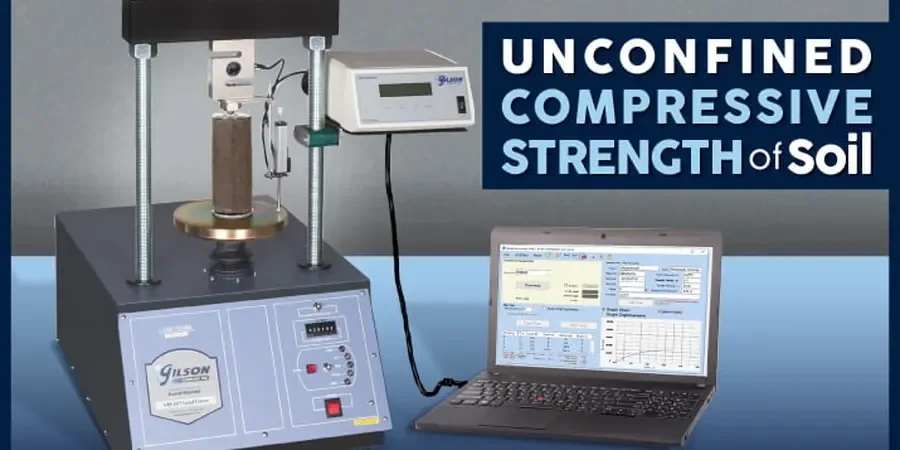
The unconfined compression test on Santa Ana alluvial clays typically delivers undrained shear strengths between 0.3 and 1.2 kg/cm², directly applicable to shallow foundation design.
Scope of work in Santa Ana
Risks and considerations in Santa Ana
The most common mistake in Santa Ana is relying on empirical correlations from nearby cities without direct UCS testing. The alluvial clays here have distinct plasticity and moisture sensitivity that generic tables cannot capture. A contractor once designed a footing for a 0.5 kg/cm² allowable bearing capacity based on a visual log alone — the UCS later showed only 0.25 kg/cm². The redesign cost two weeks and extra concrete. Skipping the unconfined compression test on these clays risks differential settlement, cracked slabs, and expensive retrofits. The test is inexpensive relative to the damage it prevents.
Our services
Our geotechnical lab in Santa Ana offers specialized testing tailored to local soil conditions.
Standard UCS with Moisture Content
Includes undisturbed tube sampling, trimming, axial loading per ASTM D2166, plus natural moisture content determination. Report provides qu, Su, failure strain, and stress-strain curve.
UCS with Unit Weight & Classification
Adds bulk and dry unit weight measurement plus visual-manual soil classification (ASTM D2488). Ideal for shallow foundation projects needing complete strength and density data.
Q&A
How long does the unconfined compression test take in Santa Ana?
From sample arrival to final report, the test takes 3 to 5 business days. The actual loading phase lasts 10 to 20 minutes per specimen, but sample preparation and moisture determination add time.
What is the cost range for a UCS test in Santa Ana?
The typical cost for a standard unconfined compression test (ASTM D2166) in Santa Ana ranges from US$300 to US$550 per specimen, depending on whether moisture content and unit weight are included. Volume discounts apply for multi-sample projects.
Can I use UCS results for all foundation types in Santa Ana?
UCS is most reliable for shallow foundations (spread footings, mats) on saturated cohesive soils. For deep foundations or granular soils, we recommend the triaxial test or SPT with torque. UCS alone does not account for confining stress changes at depth.
What sample quality is required for a valid UCS test?
Only undisturbed tube samples (thin-walled Shelby tubes per ASTM D1587) are acceptable. Disturbed or remolded samples yield unreliable strength values. The sample must have a height-to-diameter ratio of 2.0 to 2.5 and be free of visible cracks or gravel.