Santa Ana sits within the coastal plain of Orange County, where the underlying geology transitions from alluvial fans to older terrace deposits. This layered sequence often includes interbedded sands, silts, and clays with variable groundwater depths. For any cut or fill steeper than 3H:1V, a slope stability analysis is required by local grading ordinances. The analysis must account for seismic loading per ASCE 7, given the region's proximity to the Newport-Inglewood fault zone. Before modeling, site conditions are investigated through test pits to log stratigraphy and collect undisturbed samples for shear strength testing.
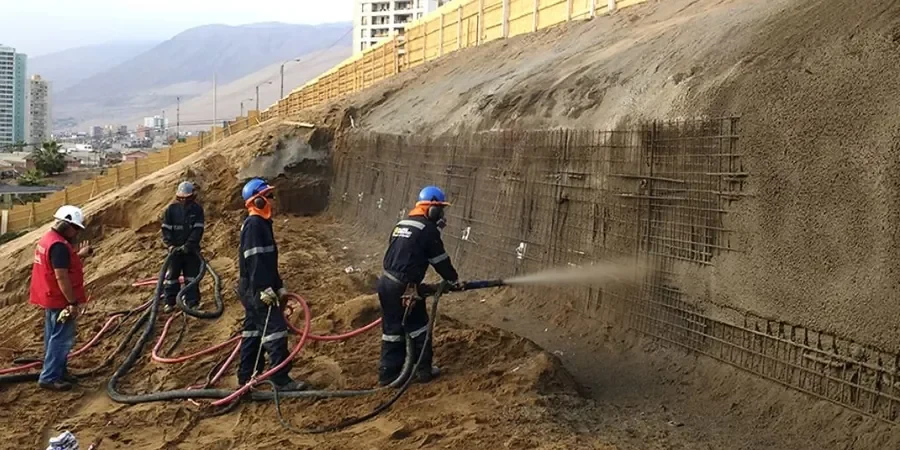
Limit equilibrium methods remain standard for most cuts, but finite element models become essential when slopes interact with adjacent foundations or utilities.
Scope of work in Santa Ana
Risks and considerations in Santa Ana
A recent residential development on a 15-meter cut slope near 17th Street experienced a shallow planar failure during the rainy season. The slope had been designed with a 2:1 face and no subsurface drainage. Water seepage along a silt seam reduced effective stress below the critical threshold. A thorough slope stability analysis would have identified the need for horizontal drains or a flatter geometry. In Santa Ana, winter storms can drop 300 mm of rain in two months, raising the water table enough to trigger failures in marginally stable cuts. Ignoring groundwater modeling is the most common mistake.
Our services
Our team provides a complete suite of services for slope stability analysis in Santa Ana, from field investigation to numerical modeling and final report.
Limit Equilibrium Modeling
We use SLIDE and SLOPE/W to compute factors of safety using Bishop, Spencer, and Morgenstern-Price methods. Models include seismic coefficients per ASCE 7 and groundwater scenarios based on monitoring well data.
Shear Strength Testing
Direct shear (ASTM D3080) and consolidated undrained triaxial (ASTM D4767) tests on undisturbed samples. Results provide c' and phi' for each soil layer, critical for reliable stability calculations.
Finite Element Analysis
For complex geometries or when slopes support structures, we run 2D FE models (RS2, PLAXIS) that capture stress redistribution, deformation, and progressive failure mechanisms.
Q&A
When is a slope stability analysis required in Santa Ana?
Any cut or fill steeper than 3H:1V that is higher than 1.5 meters requires analysis per IBC Chapter 18 and most Orange County grading ordinances. Also required when building near existing slopes or on hillside lots.
What is the typical cost for a slope stability analysis in Santa Ana?
Costs range between US$1.440 and US$3.720 depending on slope height, number of sections analyzed, and whether laboratory testing is included. Complex projects with seismic analysis or FE modeling fall at the higher end.
How is groundwater handled in the analysis?
Groundwater is modeled using monitoring well data and seasonal high water table estimates. Piezometric surfaces are incorporated into limit equilibrium and FE models. In Santa Ana's alluvial soils, perched water tables are common and must be included.
What factor of safety is required for slopes in Santa Ana?
IBC 2021 requires a minimum factor of safety of 1.5 for static conditions and 1.1 for seismic (pseudostatic) loading. Local jurisdictions may ask for 1.3 for short-term construction conditions or 1.6 for critical slopes adjacent to structures.