ASCE 7 and the California Building Code require site-specific soil classification for any new construction in Santa Ana. We use grain size analysis (sieve + hydrometer) to determine the exact particle distribution of the soil. This data is critical for assigning the correct site class under IBC 2018. Santa Ana sits on deep alluvial deposits with interbedded clays and sands. A poorly classified soil can lead to an incorrect seismic design category. We follow ASTM D422 for the full hydrometer curve and ASTM D6913 for the sieve portion. Before we recommend any foundation solution, we first confirm the soil type through this test. It pairs well with a full study of soil mechanics to define shear strength and consolidation behavior.
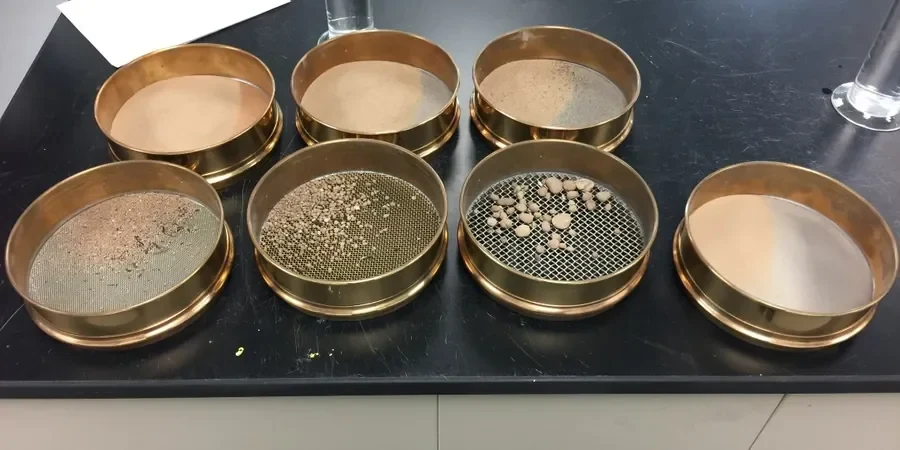
A missing hydrometer curve on a fine-grained soil can hide up to 30% of the clay fraction, leading to a misclassification of the site.
Scope of work in Santa Ana
- Sieve separation down to No. 200 sieve (0.075 mm)
- Hydrometer sedimentation in a controlled-temperature bath for the clay fraction
- Correction for dispersant and temperature per ASTM D422
- Combined gradation curve with D10, D30, D60 and uniformity coefficient
Risks and considerations in Santa Ana
A contractor we worked with near the Civic Center skipped the hydrometer portion and classified a fat clay (CH) as a lean clay (CL). The foundation design underestimated the swelling potential by a factor of two. That mistake cost them a slab replacement six months later. In Santa Ana, the shallow soils often contain expansive clays from the older alluvial fans. Without the full hydrometer curve, you miss the fraction below 0.002 mm — the active clay. The sieve alone cannot separate silt from clay. We always run the full grain size analysis (sieve + hydrometer) for projects west of Harbor Boulevard, where the clay content is historically higher.
Our services
We deliver three complementary services around grain size analysis in Santa Ana:
Full Gradation Curve (Sieve + Hydrometer)
Complete particle size distribution from 75 mm down to 0.001 mm. Includes USCS classification, coefficients of uniformity and curvature, and a professional report stamped by a licensed geotechnical engineer.
Hydrometer Analysis Only (Fine Fraction)
Targeted sedimentation test for the fraction passing No. 200 sieve. Used when only the clay and silt content is needed for plasticity or consolidation assessments. Runs per ASTM D422 with full temperature corrections.
Sieve Analysis for Aggregates and Coarse Soils
Dry or wet sieve up to 3-inch openings. Suitable for base course, backfill, and coarse-grained soils where the fines content is below 5%. Reports gradation to Caltrans or local agency specs.
Q&A
What is the difference between sieve analysis and hydrometer analysis?
Sieve analysis separates soil particles down to 0.075 mm (No. 200 sieve). The hydrometer analysis measures particles smaller than that, down to 0.001 mm, by measuring the sedimentation rate in a water column. In Santa Ana soils, the hydrometer is essential because the clay fraction often controls the swelling behavior.
How much does a grain size analysis cost in Santa Ana?
The typical range for a full sieve plus hydrometer test in Santa Ana is between US$100 and US$200 per sample. This includes sample preparation, the sedimentation readings, and a complete gradation curve with USCS classification. Volume discounts apply for projects with more than 10 samples.
How long does the hydrometer test take?
The sedimentation readings span 24 hours, with the first reading at 30 seconds and the last at 24 hours. The total turnaround for a full grain size analysis (sieve + hydrometer) is typically 3 to 5 business days from sample receipt. We can expedite to 48 hours for an additional fee.