We saw it firsthand on a 10-story mixed-use project near the Santa Ana Civic Center. The geotechnical report from a neighboring lot used only SPT blow counts, and the design team assumed uniform dense sand across the site. When we ran a CPT (Cone Penetration Test) along the proposed foundation line, the cone tip resistance dropped from 15 MPa to under 4 MPa within two meters, revealing a buried channel of loose silty sand that SPT had missed entirely. That single profile saved the owner from a differential settlement problem that would have surfaced during finishing. In Santa Ana, where the Santa Ana River floodplain deposits create abrupt lateral variability, a continuous CPT log is the only way to catch these hidden transitions before you commit to a foundation layout. Pairing the CPT with asentamientos predictions gives the structural team real numbers to work with.
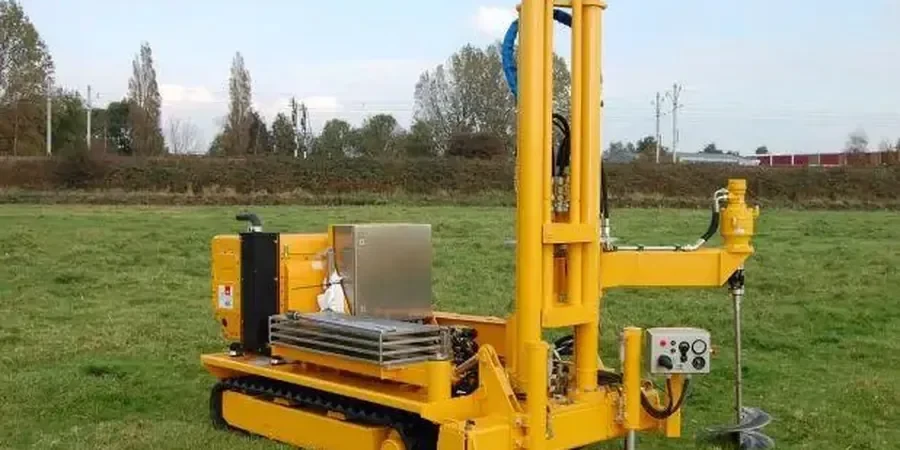
Continuous CPT profiling at 2 cm intervals catches thin weak layers that SPT blow counts routinely average out.
Scope of work in Santa Ana
Risks and considerations in Santa Ana
Santa Ana's urban growth accelerated rapidly after the 1950s, with large tracts of former citrus groves and river terraces converted into commercial and residential zones. Much of the city sits on Holocene alluvium deposited by the Santa Ana River, a system that shifts course historically. These deposits include loose sands, soft silts, and occasional clay lenses that can consolidate under load. Without a CPT (Cone Penetration Test), a project risks designing for average conditions while a localized soft layer goes undetected. We have documented cases where post-construction cracks appeared within two years because the foundation pads straddled zones of contrasting stiffness. A single CPT sounding at a critical column location catches that variability before concrete is poured.
Our services
We offer four specialized CPT services tailored to Santa Ana's subsurface conditions:
Seismic CPT (SCPT)
Adds a downhole shear-wave velocity measurement every meter using a geophone embedded in the cone. Critical for site class per ASCE 7 in the alluvial basin.
Piezocone Dissipation Tests
Stops penetration at selected depths to record pore pressure decay. Determines in-situ coefficient of consolidation for soft clay layers below the water table.
CPT Soil Behavior Type (SBTn)
Uses normalized tip resistance and friction ratio to classify each 2 cm interval into 9 soil types per Robertson 1990. Generates a continuous stratigraphic log.
CPT-Based Liquefaction Assessment
Applies the Robertson & Wride 1998 method to compute cyclic resistance ratio from qc and fs. Produces a factor-of-safety profile for seismic design in loose sands.
Q&A
What is the difference between CPT and SPT for Santa Ana soils?
CPT provides a continuous profile every 2 cm, while SPT gives discrete blow counts at 1.5 m intervals. In Santa Ana's interbedded alluvium, CPT detects thin weak layers that SPT averages out, making it more reliable for foundation design in variable deposits.
How deep can a CPT sounding reach in Santa Ana?
Standard 20-tonne cone trucks typically reach 30 to 40 meters in Santa Ana's alluvial sands and silts. In denser older deposits near the Santiago Creek area, refusal may occur at shallower depths. We can mobilize heavier rigs if deeper penetration is needed.
How much does a CPT (Cone Penetration Test) cost in Santa Ana?
A standard CPT sounding in Santa Ana runs between US$140 and US$280 per meter, depending on depth, access conditions, and whether seismic or dissipation measurements are added. Mobilization within Orange County is typically included in the rate.
What certifications does your CPT equipment carry?
Our cone penetrometers are calibrated annually to ASTM D5778 standards with traceable load cells and pressure transducers. The data acquisition system records at 10 Hz and outputs raw qc, fs, and u2 values for independent verification.