Soil behavior shifts noticeably between the older alluvial terraces near the Santa Ana River and the younger floodplain deposits around South Bristol Street. In the river terraces you typically encounter dense sands and gravels that yield N-values above 40, while the floodplain often presents loose silty sands with N-values below 10 down to 30 feet. This contrast means an SPT (Standard Penetration Test) must be planned with the specific sector in mind; a single approach across Santa Ana simply doesn't work. Our geotechnical team has performed hundreds of these borings across the city, from the Civic Center area to the industrial zones near the 5 freeway, and we consistently see how local geology drives the sampling strategy.
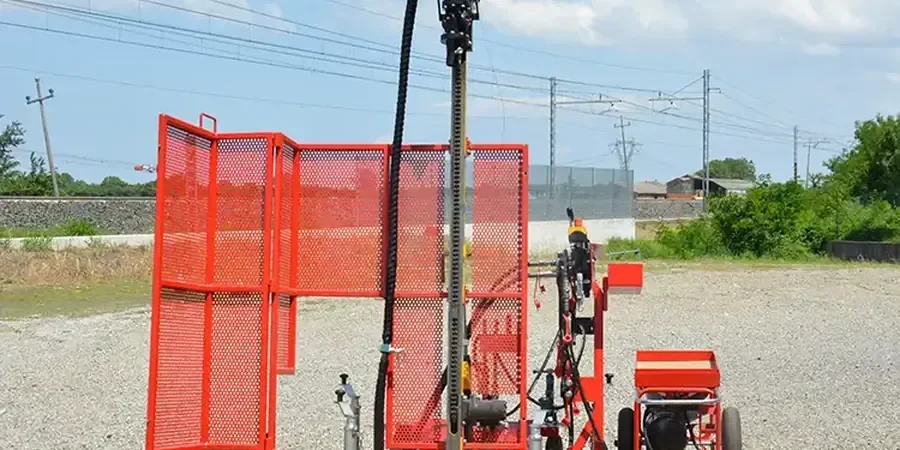
An SPT in Santa Ana's alluvium can show N-values ranging from 4 in loose fills to over 50 in dense river gravels — a 12x variation within a single mile.
Scope of work in Santa Ana
Risks and considerations in Santa Ana
The most common mistake we see in Santa Ana is contractors relying on a single SPT boring to characterize an entire parcel, especially on lots near the river where soil lenses change within 50 feet. That lone boring might hit a gravel pocket and report N=45, while 30 feet away the foundation sits on loose silt with N=6. Without multiple SPT locations or a complementary test pit program to visually log stratification, the foundation design can be dangerously under-specified. We always recommend a minimum of three borings for any building footprint over 5,000 square feet in this city.
Our services
Beyond the SPT itself, we provide complementary services that help you build a complete subsurface model for any Santa Ana project.
Seismic Site Classification
Using SPT N-values to assign Site Class per ASCE 7 (A through F) for seismic design in Santa Ana's moderate hazard zone.
Liquefaction Potential Analysis
SPT-based simplified procedure per Youd-Idriss (2001) to evaluate liquefaction risk in saturated sands below the water table.
Foundation Bearing Capacity
Correlating corrected N60 values to allowable bearing capacity using Terzaghi and Meyerhof methods for spread footings.
Soil Sampling and Retrieval
Disturbed and undisturbed samples recovered during SPT for lab testing — moisture content, unit weight, and grain-size distribution.
Q&A
How many SPT borings are needed for a typical residential lot in Santa Ana?
For a single-family home on a 7,500 sq ft lot, we recommend two to three SPT borings to a depth of 30-40 feet. The variability of Santa Ana's alluvial deposits, especially near the river, makes a single boring unreliable for foundation design.
What is the typical cost range for an SPT test in Santa Ana?
Standard SPT borings in Santa Ana range from US$510 to US$680 per boring, including mobilization, drilling, sampling, and basic soil classification. Deeper borings or those requiring traffic control add to the cost.
How does the SPT help with liquefaction assessment in Santa Ana?
SPT N-values are the primary input for the simplified liquefaction evaluation method (Youd-Idriss 2001). In Santa Ana, where the water table is shallow (12-18 ft) and loose sands are common, corrected N60 values below 20 often indicate moderate to high liquefaction potential during a seismic event.
Can SPT be performed in gravelly soils common near the Santa Ana River?
Yes, but it can be challenging. In gravels, the split-spoon sampler may refuse prematurely or get damaged. We often switch to a larger-diameter sampler or supplement with CPT to get continuous resistance data through those coarse layers.