Development pressures in Santa Ana differ sharply between the flat alluvial terraces near the Santa Ana River and the steeper terrain along the Santiago Creek corridor. The river terrace deposits consist of dense sands and gravels with low collapsibility, while the hillside lots often contain older alluvial fan materials interbedded with clay seams. That contrast matters for debris flow analysis because the triggering mechanisms and runout paths change completely. A home on a river terrace might face sheet flooding, but a property cut into the Santiago Creek slope can experience concentrated channelized debris flows during winter storms. Before any grading permit, the city requires a quantitative debris flow analysis for lots with a drainage area exceeding 3 acres or slopes above 15 percent. Our team uses the LA Basin-specific rainfall intensity-duration thresholds and the USGS debris-flow hazard assessment methodology to deliver results that meet both ASCE 7 and local ordinance requirements.
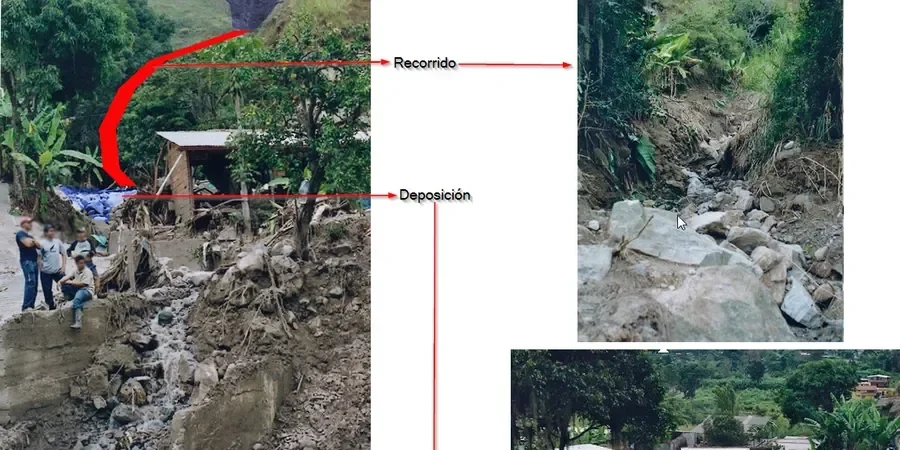
A 100-year storm on a post-fire hillside in Santa Ana can mobilize debris volumes exceeding 10,000 cubic yards per square mile.
Scope of work in Santa Ana
Risks and considerations in Santa Ana
A 15-lot subdivision on a former citrus orchard off Red Hill Avenue required debris flow analysis after the 2020 Silverado Fire burned the adjacent Loma Ridge. The post-fire debris flow hazard increased by a factor of 10 because the hydrophobic soils reduced infiltration and amplified runoff. Our analysis showed that a 50-year storm could produce a debris flow with a peak discharge of 85 m³/s at the canyon mouth, exceeding the capacity of the existing 48-inch culvert. The county required a debris basin with 12,000 m³ storage and a concrete drop structure to dissipate energy. Without that analysis, the development would have faced a 30% probability of debris inundation during the design life. The mitigation added $1.2 million to the project cost but reduced the residual risk to below the 1% annual exceedance threshold required by the city.
Our services
We provide four integrated analysis components that cover the full debris flow assessment cycle, from source identification to mitigation design.
Hillside Hazard Mapping
Field reconnaissance and GIS-based mapping of debris source areas, transport zones, and deposition fans. Uses LiDAR-derived slope maps and soil burn severity classifications from post-fire assessments.
Hydrologic and Hydraulic Modeling
Rainfall-runoff analysis using HEC-HMS and debris flow routing with FLO-2D. Calibrated against Orange County flood control gauge data and historical debris flow events in the Santa Ana Mountains.
Impact and Structure Design
Calculation of debris flow impact pressures, runup heights, and boulder impact forces on barriers, basins, and buildings. Designs per AASHTO LRFD and ASCE 7 load combinations.
Mitigation Plan Preparation
Grading plans, debris basin sizing, diversion berm alignment, and outlet works design. Includes construction cost estimates and maintenance schedules for the 50-year design life.
Q&A
When is debris flow analysis required in Santa Ana?
The City of Santa Ana requires a debris flow analysis for any new development or major remodel on slopes steeper than 15% with a contributing drainage area over 3 acres. It is also mandatory for any project in a Very High Fire Hazard Severity Zone, as mapped by CAL FIRE, when a wildfire has occurred within the last 10 years. The analysis must be signed by a licensed civil engineer and submitted with the grading permit application.
What is the typical cost range for a debris flow analysis in Santa Ana?
The cost for a debris flow analysis in Santa Ana typically ranges from US$1,310 to US$3,910, depending on the watershed size, complexity of terrain, and whether post-fire conditions exist. A simple single-lot analysis with a small drainage area falls at the lower end, while a multi-lot subdivision with multiple flow paths and mitigation design reaches the upper range. The fee includes field reconnaissance, modeling, and a stamped report.
How does a debris flow differ from a mudflow in terms of engineering analysis?
A debris flow contains coarse material—boulders, cobbles, woody debris—moving as a viscous slurry with sediment concentrations above 0.5 by volume. Mudflows have higher water content and finer sediment (silt and clay). The engineering analysis differs in the rheological model: debris flows require a Bingham or Voellmy model to capture yield stress and granular friction, while mudflows are modeled as turbulent Newtonian fluids. The impact pressures also differ significantly, with debris flows exerting boulder impact loads up to 500 kPa.